
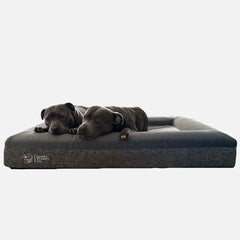


The Staffordshire Bull Terrier and American Pit Bull Terrier (APTB) are separate breeds, with the Staffy being shorter and more compact, while the Pit Bull is generally taller, leaner and more athletic.
The confusion between them comes from their shared bull-and-terrier ancestry and similar physical traits. Both can have muscular bodies, broad heads and short coats, but their size, proportions, breed recognition and development differ considerably.
The Staffordshire Bull Terrier, commonly called the Staffy, originated in Britain and is recognised as a distinct breed by major kennel organisations. The American Pit Bull Terrier was developed in the United States and follows a separate breed standard. The term “Pit Bull” is also used loosely for several similar-looking dogs, including American Staffordshire Terriers and mixed breeds, which can make visual identification unreliable.
Both breeds are strong, energetic and highly people-focused. They need consistent training, daily exercise and suitable mental stimulation, such as interactive dog toys, to help keep them engaged. Their temperament, activity needs, health and suitability for different households reveal the most important distinctions between them.
Key Takeaways
-
The Staffordshire Bull Terrier and American Pit Bull Terrier are separate breeds.
-
Staffies are usually shorter, broader and more compact.
-
American Pit Bull Terriers are generally taller, leggier and more athletic.
-
Both require consistent training, daily exercise and responsible supervision.
-
Appearance alone cannot always confirm whether a dog is a Staffy, Pit Bull or mixed breed.
Staffordshire Bull Terrier vs Pit Bull at a Glance
The most dependable distinction is overall proportion. A Staffy concentrates considerable muscle and bone into a short frame, while an American Pit Bull Terrier typically has longer legs, greater reach and a more athletic silhouette.
|
Feature |
Staffordshire Bull Terrier |
American Pit Bull Terrier |
|
Common abbreviation |
Staffy or Stafford |
APBT |
|
Development |
Great Britain |
United States |
|
Formal status |
Recognised by Dogs Australia, AKC and UKC |
Recognised by UKC, but not AKC |
|
Height |
36 to 41 cm |
Females 43 to 51 cm; males 46 to 53 cm |
|
Weight |
Females 11 to 15 kg; males 13 to 17 kg |
Females 14 to 23 kg; males 16 to 27 kg |
|
General build |
Short, compact and heavy-boned for its size |
Taller, balanced and visibly athletic |
|
Head |
Short and deep with a broad skull and pronounced cheeks |
Broad and wedge-shaped with a relatively longer muzzle |
|
Typical activity style |
Energetic play, walks and close family interaction |
Sustained exercise, training and athletic activities |
|
Coat |
Short and smooth |
Short and smooth |
|
Australian import status |
Not on the federal prohibited breed list |
Pure APBTs and Pit Bull Terriers cannot be imported |
These measurements reflect the official United Kennel Club breed standards. The Staffy standard specifies a height of 14 to 16 inches, while the APBT standard describes females at 17 to 20 inches and males at 18 to 21 inches.
What Does “Pit Bull” Actually Mean?
“Pit Bull” can mean the American Pit Bull Terrier or function as an informal label for several similar-looking bull breeds.
The phrase does not always identify one specific breed. In everyday conversation, news reporting, housing policies and shelter records, it may be applied to American Pit Bull Terriers, American Staffordshire Terriers, Staffordshire Bull Terriers and mixed-breed dogs with broad heads or muscular bodies.
That broad usage makes accurate comparison difficult. The American Kennel Club does not recognise “Pit Bull” as an individual breed, although it separately recognises the Staffordshire Bull Terrier and American Staffordshire Terrier. The United Kennel Club recognises the American Pit Bull Terrier under its own standard.
The Staffy Is Not an AmStaff
A Staffordshire Bull Terrier is also different from an American Staffordshire Terrier, commonly called an AmStaff.
The Staffy is the smaller British breed discussed in this article. The AmStaff is a larger American breed with its own standard and recognition history. In Australia, “Staffy” most commonly refers to the Staffordshire Bull Terrier, but checking the dog’s registered breed name prevents misunderstandings.
Different Breed Histories
The Staffy developed as a compact British breed, while the American Pit Bull Terrier was refined in the United States as a versatile working and companion dog.
Both descend from historical bull-and-terrier crosses, but their development followed different paths.
The Staffordshire Bull Terrier was established in Great Britain and became known for combining physical strength with an affectionate, people-focused nature. Dogs Australia classifies it as a recognised pure breed within the terrier group and describes it as muscular, active and agile despite its compact dimensions.
Dogs of similar British ancestry were taken to the United States during the nineteenth century. There, the American Pit Bull Terrier developed into a larger, more athletic dog used for farm work, property activities and companionship. The United Kennel Club first recognised the breed in 1898.
Shared ancestry explains the resemblance. Separate development explains why their current breed standards are not interchangeable.
Physical Differences
Staffies are shorter and more compact, while American Pit Bull Terriers are taller and more athletic in proportion.
A broad head or muscular chest is not enough to distinguish these dogs. Height, leg length, body proportions and movement provide a more useful overall picture.
Size and Proportions
A typical Staffy stands 36 to 41 centimetres at the shoulder. Females generally weigh about 11 to 15 kilograms, while males weigh approximately 13 to 17 kilograms.
An American Pit Bull Terrier is noticeably taller. Females typically stand around 43 to 51 centimetres, while males stand approximately 46 to 53 centimetres. The recognised weight ranges extend from about 14 to 23 kilograms for females and 16 to 27 kilograms for males.
The difference is not merely a number on the scales. Staffies tend to look dense and powerful for their height. APBTs usually have more daylight beneath the body, longer limbs and an outline designed for speed, balance and sustained movement.
Head and Facial Structure
The Staffordshire Bull Terrier standard calls for a short, deep head, a broad skull and pronounced cheek muscles. Rose-shaped or half-pricked ears are considered characteristic.
The APBT also has a broad skull and strong cheeks, but the head is generally more wedge-shaped when viewed from above. Its muzzle is broad and deep without appearing as short as that of a typical Staffy.
These are tendencies rather than a visual identification formula. Mixed ancestry, breeding quality and natural variation can produce dogs that do not match an idealised breed image.
Coat and Colour
Both breeds have short, smooth coats that require relatively little grooming. Many coat colours and markings occur across bull breeds, so colour should not be treated as proof of breed.
A blue, brindle, black, red or white dog could belong to either breed or be a mix. Structure and documented ancestry carry more weight than colour.
Temperament and Personality
Both breeds are generally affectionate and people-oriented, but the American Pit Bull Terrier often has greater endurance and athletic drive.
Breed standards describe tendencies, not guaranteed behaviour. Genetics, early experience, health, training and the owner’s management all influence how an individual dog behaves.
Affection Towards People
Staffies are renowned for seeking close contact with their families. Many are enthusiastic greeters, persistent lap dogs and highly expressive companions despite their solid build.
American Pit Bull Terriers can be similarly affectionate and eager to please. The United Kennel Club standard describes confidence, enthusiasm and friendliness towards people as characteristic qualities, while identifying human-directed aggression as uncharacteristic of the breed.
Neither dog usually thrives as a detached backyard pet. Regular interaction, training and inclusion in family life are central to their wellbeing.
Behaviour Around Children
Staffies have a longstanding reputation for affection towards children, but that reputation should never be interpreted as permission to leave a dog and child unsupervised.
Both breeds are strong, excitable and capable of knocking over a small child during play. Adults should supervise every interaction, teach children not to climb on or disturb a resting dog and provide the dog with a quiet space where it will not be followed.
A dog’s individual behaviour around children should be evaluated directly rather than assumed from its breed.
Other Dogs and Pets
Neither breed is universally friendly or unfriendly towards other dogs. Some individuals enjoy canine company throughout life. Others become selective as they reach social maturity.
The APBT standard acknowledges that some degree of dog-directed aggression can occur and emphasises careful socialisation and obedience training. That does not mean every APBT will display conflict, but it does make responsible introductions and management essential.
Socialisation should teach a dog to remain calm around other animals. It does not require unrestricted play with every unfamiliar dog.
Compatibility with cats and smaller pets also varies. Early exposure may improve the chances of peaceful cohabitation, but prey drive and play intensity must still be considered.
Exercise and Training

Both breeds need daily exercise and reward-based training, although the American Pit Bull Terrier generally requires more sustained physical activity.
A Staffy may be smaller, but it is not a low-energy dog. Most enjoy brisk walks, interactive play, scent work, short training sessions and time exploring with their family.
The American Pit Bull Terrier’s longer legs and athletic construction make it especially well suited to extended walks, hiking, structured conditioning and canine sports. Veterinary care guidance commonly recommends regular exercise alongside secure handling, gradual training and positive reinforcement.
Effective Training Priorities
Training should begin with practical skills that improve safety and everyday cooperation:
-
Responding to a name
-
Walking without pulling
-
Settling on a bed or mat
-
Waiting at doors
-
Releasing objects on cue
-
Returning when called
-
Remaining calm around distractions
Both breeds can be enthusiastic and physically persistent. Positive reinforcement, short sessions and clear boundaries are more productive than harsh correction.
Impulse control deserves as much attention as physical exercise. A dog that only receives increasingly intense activity may become fitter without becoming calmer. Sniffing walks, food puzzles, decompression and rest help balance arousal.
Secure Handling Matters
A strong dog requires equipment and containment that match its abilities. Use a well-fitted collar or harness, a durable lead and secure fencing without gaps or weak gates.
These precautions are not evidence that a dog is dangerous. They are ordinary responsibilities for managing a powerful, athletic animal safely.
Home Life and Everyday Care
Either breed can live successfully in a smaller home when its exercise, enrichment and companionship needs are consistently met.
A garden is convenient, but it does not replace walks, training or interaction. Staffies are physically easier to accommodate in compact homes, although their enthusiasm and desire for attention can make them feel much larger than their measurements suggest.
APBTs usually benefit from more room to move and owners who enjoy sustained outdoor activity. Apartment living may still work when exercise is reliable and local housing rules allow the breed.
Time Alone
Both dogs can become bored or distressed when left alone for long periods without preparation. Possible signs include chewing, vocalising, pacing and attempts to escape.
Independence should be developed gradually. A predictable routine, safe chew items, food enrichment and a comfortable resting area can make short absences easier to manage.
Grooming and Comfort
The short coat requires only basic maintenance, including weekly brushing, nail trimming, ear checks and routine dental care.
Neither breed has substantial protection from temperature extremes. Shade and water are essential in hot weather, while a warm indoor sleeping area is valuable during colder months.
Their muscular bodies also benefit from a bed that cushions the shoulders, hips and elbows after exercise.
Health and Responsible Breeding
Responsible breeders should provide documented health-test results rather than relying on appearance or claims that their dogs come from healthy lines.
Staffordshire Bull Terriers commonly live around 12 to 14 years, although health and longevity vary between individuals. Conditions considered in responsible Staffy breeding include hereditary cataracts and L-2-hydroxyglutaric aciduria, a genetic metabolic disorder affecting the nervous system. Dogs Australia advises breeders to test for both conditions.
Staffies may also experience skin problems, patellar issues and hip or elbow conditions. Dogs with extremely shortened muzzles should be approached cautiously because exaggerated head structure can interfere with comfortable breathing.
Health concerns reported in American Pit Bull Terriers include hip dysplasia, allergic skin disease, eye disorders and excess weight. Prospective owners should request documented orthopaedic and eye screening and ask about health patterns among close relatives.
For either breed, long-term joint health is supported by:
-
Maintaining a lean body condition
-
Building exercise intensity gradually
-
Avoiding excessive repetitive impact in growing puppies
-
Providing recovery days after strenuous activity
-
Using a supportive sleeping surface
Can Appearance Confirm the Breed?
Visual identification cannot consistently distinguish a Staffy, American Pit Bull Terrier or mixed-breed dog.
Muscular bodies, broad heads and short coats occur across numerous breeds and crosses. Even trained shelter workers do not always agree when assigning a Pit Bull-type label from appearance.
In one study involving 120 shelter dogs, DNA analysis identified 25 dogs as Pit Bull-type, while shelter staff collectively applied that classification to 62 dogs. The difference illustrates how easily appearance-based labels can overidentify or misidentify dogs.
Registered pedigree records provide stronger evidence of breed identity than photographs. DNA tests may offer ancestry estimates for an unregistered dog, but they do not convert it into a formally registered purebred animal.
This distinction matters when housing, insurance, council rules or travel arrangements depend on breed classification.
Australian Ownership and Import Considerations
Australia permits the importation of Staffordshire Bull Terriers but prohibits the importation of pure American Pit Bull Terriers and Pit Bull Terriers.
The federal prohibited breed list treats the Staffy and APBT as different dogs. A Staffordshire Bull Terrier is not included on the prohibited import list, while a pure American Pit Bull Terrier or Pit Bull Terrier cannot be imported into Australia.
Local obligations may extend beyond federal import rules. State, territory and council requirements can affect registration, containment and the management of individual dogs. Rental agreements and insurers may impose additional conditions.
Owners should verify the rules applying to their location rather than relying on a dog’s appearance or an informal breed description.
Which Breed Is Right for You?

The better match depends on the individual dog, the owner’s activity level and the household’s ability to provide training, companionship and secure management.
A Staffordshire Bull Terrier may be the more practical choice for someone seeking a smaller, highly affectionate dog that can participate in daily walks, play and family life. Its compact size can suit suburban or smaller homes, but its energy and physical enthusiasm should not be underestimated.
An American Pit Bull Terrier may appeal to an experienced, active owner who wants a taller athletic partner for structured exercise and ongoing training. Secure containment and awareness of local legal or housing restrictions are particularly important.
Neither breed should be chosen solely for appearance. Before making a decision, consider:
-
The dog’s observed temperament
-
Its health and breeding history
-
Behaviour around existing pets
-
Comfort with children and visitors
-
Exercise and training requirements
-
The support available from the breeder or rescue organisation
-
Relevant council, housing and insurance rules
A well-matched individual from a responsible source is more important than choosing between two breed labels.
The Clearest Difference Comes Down to Proportion
The Staffordshire Bull Terrier is a shorter, more compact British breed. The American Pit Bull Terrier is a taller, more athletic American breed. They share historical roots and several physical characteristics, but they are not interchangeable.
Whichever dog joins the household will need structured exercise, patient training, secure management and plenty of recovery time.
After an active day, give those hardworking muscles and joints the support they deserve. Explore Happy Staffy’s durable, joint-friendly dog beds and create a more comfortable place for your dog to rest, recover and recharge.
Frequently Asked Questions
Is a Staffy Stronger Than a Pit Bull?
A Staffordshire Bull Terrier is exceptionally strong for its compact size, but an American Pit Bull Terrier is generally taller, heavier and capable of producing greater overall physical power. Individual strength depends on the dog’s size, fitness, age and health rather than breed alone.
How Do I Tell if My Dog Is a Staffy or Pit Bull?
Staffies are usually shorter and more compact, with a broad skull, pronounced cheek muscles and a shorter muzzle. American Pit Bull Terriers tend to have longer legs, a leaner athletic frame and a comparatively longer muzzle. Appearance alone cannot confirm breed ancestry, so pedigree records or a canine DNA test may provide better evidence.
Are Staffordshire Terriers the Same as Pit Bulls?
Not exactly. The Staffordshire Bull Terrier, American Staffordshire Terrier and American Pit Bull Terrier are separate recognised breeds, although they share bull-and-terrier ancestry and similar physical traits. The informal term “Pit Bull” is sometimes applied broadly to all three, which creates confusion.
Is a Staffordshire Terrier Considered an Aggressive Breed?
Staffordshire Bull Terriers are not naturally aggressive towards people when responsibly bred, socialised and trained. They are generally affectionate and people-focused, although some individuals may be selective around other dogs. Behaviour is influenced by genetics, early experiences, health, training and owner management.
Which Is Bigger, a Staffy or a Pit Bull?
The American Pit Bull Terrier is generally bigger. Staffies usually stand 36 to 41 centimetres tall and weigh approximately 11 to 17 kilograms, while American Pit Bull Terriers are typically taller and may weigh up to about 27 kilograms.
Can Staffies and Pit Bulls Live With Other Dogs?
Both breeds can live successfully with other dogs, but compatibility varies between individuals. Calm introductions, early socialisation, supervision and separate resources can reduce conflict. Some dogs may become more selective as they mature, so interactions should be managed according to behaviour rather than breed assumptions.


